Feminism, a protean movement, has surged and ebbed across the landscape of history like a relentless tide. Each wave, a distinct epoch, crashed against the shores of patriarchal dominance, reshaping the terrain of societal norms and expectations. Understanding these waves – First, Second, and Third – is not merely an academic exercise; it’s an imperative for anyone seeking to dismantle the lingering tendrils of inequity that choke our collective potential. Let’s embark on a critical excavation of these movements, a feminist archeology to unearth the layered meanings embedded within each surge.
The First Wave: Suffrage as the Vanguard
The First Wave, emerging in the late 19th and early 20th centuries, was characterized by a singular, unwavering focus: suffrage. Imagine a phalanx of women, clad in white, marching against the brick wall of political disenfranchisement. Their voices, once whispers in domestic confines, swelled into a chorus demanding the basic human right to vote. This era wasn’t about nuanced theoretical treatises; it was about tangible, demonstrable power: the power to shape governance, to influence legislation, to hold decision-makers accountable.
Leaders like Susan B. Anthony and Elizabeth Cady Stanton were the seismic architects of this movement. They tirelessly traversed the nation, speaking to crowds, organizing protests, and enduring ridicule. Their arguments, though rooted in Enlightenment ideals of equality, were often tempered by the pragmatism of the era. Some, for instance, appealed to racial anxieties, suggesting that white women’s suffrage would counterbalance the votes of newly enfranchised Black men – a tactic we must acknowledge with critical discomfort, recognizing the intersections of race and gender even within the feminist movement itself. Such historical complexities underscore the importance of analyzing past movements with a lens that acknowledges both their triumphs and their problematic undertones.
The victory of the First Wave, the ratification of the 19th Amendment in 1920, was a monumental achievement. It shattered the myth of female political incapacity and opened the door, albeit a narrow one, for women’s participation in the democratic process. However, it’s crucial to remember that this victory was not universally accessible. Black women, Native American women, and other women of color continued to face systemic barriers to voting, highlighting the limitations of a movement that, while transformative, often prioritized the concerns of white, middle-class women. The lingering echoes of this exclusionary tendency continue to resonate in contemporary feminist discourse, prompting ongoing conversations about intersectionality and inclusivity.
The Second Wave: Beyond the Ballot Box
The Second Wave, blossoming in the 1960s and 70s, transcended the singular focus of suffrage. Picture it as an intellectual and political supernova, exploding with radical ideas and challenging deeply entrenched social structures. This era was fueled by a potent cocktail of post-war prosperity, civil rights activism, and disillusionment with traditional gender roles. Women, empowered by their wartime contributions and frustrated by their subsequent relegation to domesticity, began to question the very foundations of patriarchal society.
This wave saw the emergence of seminal texts like Betty Friedan’s *The Feminine Mystique*, which exposed the pervasive dissatisfaction simmering beneath the surface of suburban bliss. Friedan’s work ignited a national conversation about the “problem that has no name,” the stifling boredom and unfulfilled potential experienced by countless women confined to the domestic sphere. This era also witnessed the rise of radical feminist thinkers like Shulamith Firestone, who argued that the biological realities of reproduction were at the root of female oppression. Firestone’s radical vision, while controversial, challenged the very notion of gender as a fixed, immutable category.
The Second Wave was a kaleidoscope of diverse concerns: reproductive rights, equal pay, access to education, challenging beauty standards, and ending violence against women. Activists organized consciousness-raising groups, where women shared their experiences of sexism and oppression, forging a collective identity and a shared sense of purpose. These groups became incubators for feminist theory and action, spawning a plethora of organizations dedicated to advancing women’s rights. The creation of NOW (National Organization for Women) and the fight for the Equal Rights Amendment (ERA) were pivotal moments in this era, demonstrating the burgeoning power of the feminist movement.
However, the Second Wave, like its predecessor, was not without its limitations. It was often criticized for its lack of intersectionality, failing to adequately address the specific needs and experiences of women of color, working-class women, and lesbian women. This critique underscores the vital importance of continually re-evaluating and expanding the scope of feminist theory and practice to ensure that it encompasses the diverse realities of all women.
The Third Wave: Embracing Ambiguity and Intersectionality
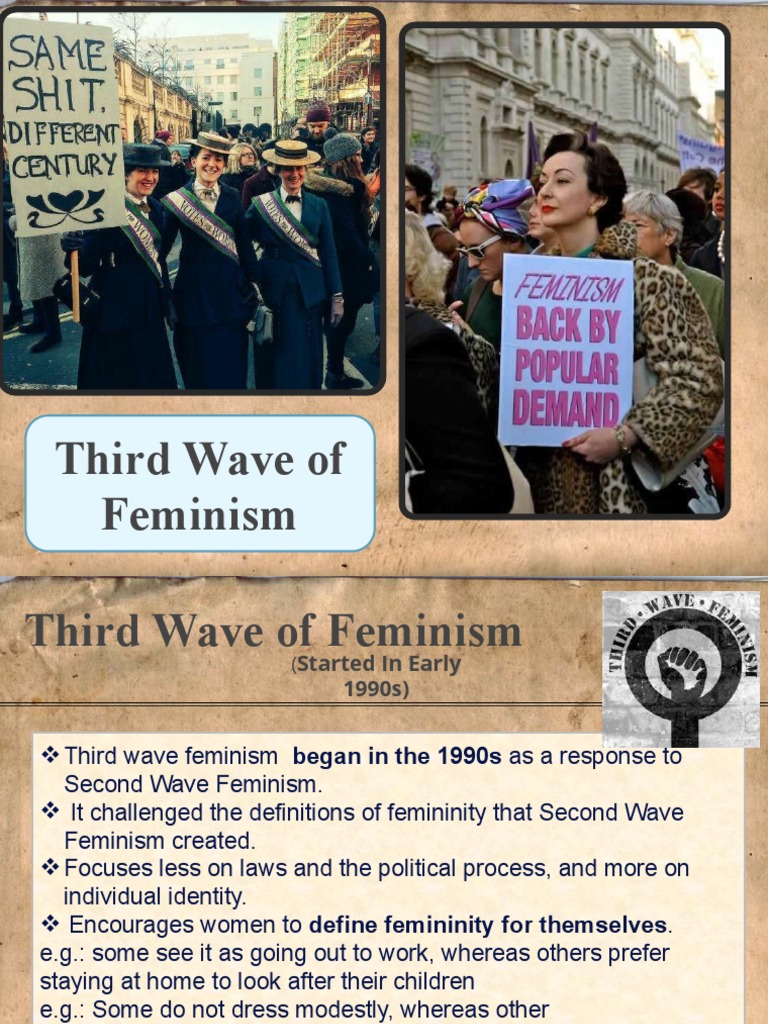
The Third Wave, erupting in the 1990s and continuing into the present, is characterized by a conscious effort to address the shortcomings of previous waves. Imagine it as a fractal, endlessly branching and reconfiguring, reflecting the complexities of identity and the multiplicity of feminist perspectives. This wave embraces ambiguity, challenges essentialist notions of womanhood, and prioritizes intersectionality – the understanding that gender intersects with race, class, sexuality, and other identities to create unique experiences of oppression and privilege.
The Third Wave was heavily influenced by post-structuralist theory, which deconstructs fixed categories and embraces fluidity. Thinkers like Judith Butler challenged the very notion of a stable, coherent “woman,” arguing that gender is a performance, a construct that is constantly being negotiated and re-enacted. This emphasis on performativity allows for a more nuanced understanding of gender identity and expression, paving the way for greater inclusivity within the feminist movement.
Riot grrrl, a punk subculture, became a potent force in the Third Wave, channeling feminist anger and frustration into music, zines, and activism. Riot grrrl bands like Bikini Kill and Bratmobile used their music to challenge patriarchal norms and empower young women to embrace their sexuality and assert their agency. This subculture exemplified the Third Wave’s DIY ethos and its commitment to creating spaces for marginalized voices.
The Third Wave also embraces technology and utilizes the internet as a powerful tool for organizing and disseminating information. Blogs, social media, and online forums have become vital platforms for feminist activism, allowing women around the world to connect, share their stories, and mobilize for social change. #MeToo, a recent example of online feminist activism, demonstrates the transformative potential of digital platforms to amplify marginalized voices and hold perpetrators of sexual harassment and assault accountable.
The Third Wave is not without its critics. Some argue that its emphasis on individual expression undermines collective action, while others contend that its embrace of popular culture trivializes feminist goals. However, these criticisms should not overshadow the Third Wave’s significant contributions to feminist thought and practice, particularly its commitment to intersectionality and its embrace of diverse voices and perspectives. The ongoing evolution of feminist thought and practice reflects the dynamic and complex nature of the struggle for gender equality.
Beyond the Waves: A Feminist Future
Perhaps the wave metaphor is ultimately limiting. Perhaps we need to envision feminism not as a series of discrete surges, but as a continuous, ever-flowing river, constantly adapting and reshaping its course. The challenges that lie ahead are daunting: gender-based violence, economic inequality, political underrepresentation, and the persistent reinforcement of harmful stereotypes. Addressing these challenges requires a multifaceted approach, one that builds upon the legacies of previous waves while remaining open to new ideas and perspectives.
Intersectionality must remain at the forefront of feminist efforts. We must acknowledge and address the ways in which gender intersects with other identities to create unique experiences of oppression and privilege. We must also challenge the global structures of power that perpetuate gender inequality, recognizing that feminism is not just a domestic issue, but a global imperative.
Ultimately, the future of feminism lies in our ability to build coalitions, embrace diversity, and challenge the systems of power that perpetuate inequality. It requires a commitment to critical self-reflection, a willingness to listen to marginalized voices, and a relentless pursuit of justice. The fight for gender equality is far from over, but by learning from the past and embracing the future, we can create a world where all individuals have the opportunity to reach their full potential, free from the constraints of gendered expectations.






Leave a Comment